
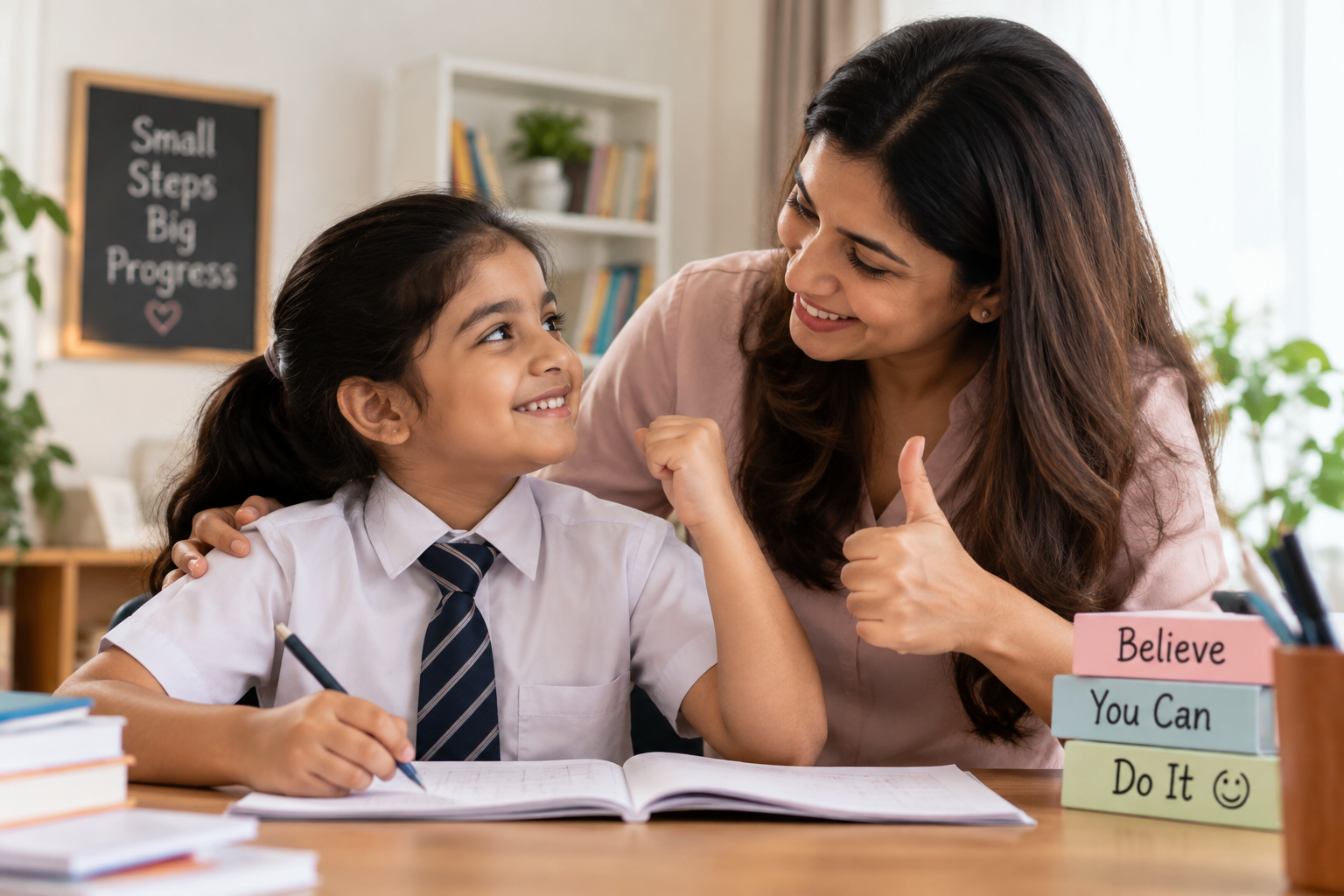
How Parents Can Build Confidence in Their Children
Confidence is one of the most important qualities a child can develop. It helps children express themselves, face challenges, make decisions, build healthy relationships, and believe in their ability to learn and grow.
A confident child does not mean a child who is never afraid or never makes mistakes. True confidence means having the courage to try, learn from mistakes, and try again.
Parents play a major role in helping children develop this confidence from an early age.
1. Encourage Effort, Not Just Results
Children need to understand that their effort is valuable, even when the result is not perfect.
Instead of focusing only on marks, ranks, or achievements, parents can appreciate the effort behind them.
Instead of:
“You got only 70 marks.”
Try:
“I can see that you worked hard. Let's see how we can improve next time.”
This helps children develop a growth mindset and understand that abilities can improve through practice.
2. Allow Children to Make Small Decisions
Giving children opportunities to make age-appropriate choices helps them develop independence.
Parents can allow children to make simple decisions such as:
* Choosing their school bag or stationery
* Planning their study time
* Selecting a book to read
* Choosing between two appropriate activities
* Organising their school materials
Small decisions gradually prepare children to make bigger decisions with confidence.
3. Let Them Make Mistakes
Mistakes are a natural part of learning.
When parents immediately solve every problem for their children, children may become afraid of making mistakes or dependent on others.
Instead, parents can ask:
“What do you think you can try?”
“What did you learn from this?”
This encourages children to think independently and view mistakes as opportunities to learn.
4. Listen Without Judging
Sometimes children simply need someone to listen.
When a child shares a problem, parents should try to listen patiently before giving advice. Avoid immediately saying things like:
* “That's nothing.”
* “You shouldn't feel like that.”
* “Why can't you be like someone else?”
Instead, acknowledge their feelings and help them think through the situation.
When children feel heard and respected, they become more comfortable expressing themselves.
5. Avoid Comparing Them With Others
Every child develops at a different pace.
Comparing a child with siblings, classmates, relatives, or friends can make them feel that they are not good enough.
Rather than asking:
“Why can't you score like your friend?”
parents can ask:
“How can we improve from where you are now?”
The goal should be progress, not comparison.
6. Give Genuine Appreciation
Children benefit from hearing specific and sincere appreciation.
Instead of simply saying “Good job!”, parents can be more specific:
* “You were very patient while completing that project.”
* “I liked the way you helped your friend.”
* “You didn't give up even when it was difficult.”
* “You spoke confidently during your presentation.”
Specific appreciation helps children understand which positive behaviours they are developing.
7. Encourage Them to Try New Things
Confidence grows through experience.
Encourage children to participate in activities such as:
* Sports
* Music
* Art
* Public speaking
* Debates
* Science projects
* Cultural activities
* School clubs
Not every activity needs to lead to an award. Participation itself teaches children to handle new experiences, challenges, teamwork, and sometimes failure.
8. Teach Them to Speak Kindly to Themselves
Children can sometimes develop negative thoughts such as:
“I can't do this.”
“I'm not good at anything.”
Parents can help them replace these thoughts with more constructive ones:
“I can't do this yet, but I can learn.”
“I can try again.”
“I may make mistakes, and that's okay.”
The way children speak to themselves can influence how they approach challenges.
9. Give Them Responsibility
Age-appropriate responsibilities can make children feel capable and trusted.
Simple responsibilities may include:
* Keeping their room organised
* Packing their school bag
* Taking care of their books
* Helping with household tasks
* Looking after personal belongings
* Completing their own homework routine
Responsibility teaches children an important message:
“I am capable of doing things on my own.”
10. Be a Positive Role Model
Children learn not only from what parents say but also from what parents do.
When parents handle mistakes calmly, accept challenges, communicate respectfully, and keep trying after setbacks, children learn these behaviours naturally.
Parents don't have to be perfect role models. Showing children that adults also make mistakes and learn from them can be powerful.
11. Create a Supportive Home Environment
A child's confidence grows when home feels like a safe place to learn, ask questions, and express opinions.
Parents can create this environment by:
* Spending quality time with their children
* Having regular conversations
* Celebrating small achievements
* Encouraging questions
* Respecting their opinions
* Providing guidance without excessive pressure
A supportive environment gives children the emotional foundation they need to face challenges outside the home.
12. Work Together With the School
Parents and teachers play different but complementary roles in a child's development.
Regular communication between parents and teachers can help identify a child's strengths, interests, challenges, and areas where encouragement may be needed.
When children see parents and teachers working together to support them, they receive a consistent message of encouragement and responsibility.
Confidence Takes Time
Building confidence is not something that happens overnight. It develops through everyday experiences—trying something new, making mistakes, receiving encouragement, solving problems, and discovering one's own strengths.
Parents don't need to remove every challenge from a child's path. Instead, they can provide the support and encouragement children need to face those challenges themselves.
Every child has unique abilities and potential. With patience, encouragement, responsibility, and a supportive environment, children can gradually develop the confidence to say:
“I can try. I can learn. I can grow.”
A Message to Parents
Let us not raise children who are afraid of making mistakes.
Let us raise children who have the courage to learn from them.
Because confidence begins when a child believes, “I am capable.”